
book review: What the world eats 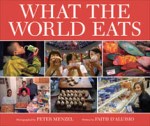
author: Faith D’Aluisio
illustrator: Peter Menzel
Tricycle Press, 2008
On this early winter morning in the Himalayan village of Shingkhey, a pot full of red rice simmers atop the low earthen stove in Nalim’s kitchen. Nalim’s grown-up daughter Sangay, a pleasant-faced woman with a ready smile, pushes another stick of wood into the fire hole to regulate the heat under the rice.
This non-fiction book features interviews and photos from 25 families in 25 countries around the world. By first asking “What do you eat for breakfast?” and very easily getting young adults to realize how differently people partake of this meal around the globe, the authors also get readers to consider nutrition, wealth, hunger and preference. Each family is introduced in a photo where they are surrounded by a week’s supply of food. Through reading, we learn what it takes for the family to obtain food items for the day or week and even how items are stored.
The Mendozas eat fruits and vegetables only when they are in season because local stores don’t have the refrigeration and transportation necessary to stock out-of-season items. Though potatoes are plentiful when Cristolina was studying in another part of Guatemala, five hours away, she didn’t eat potatoes. “The price was was incredible,” she exclaims, “twice the cost of potatoes here, and very small.” Did she miss eating potatoes? “Oh, yes,” she says.
Graphs spread throughout the book let us know things such as available daily caloric intake, annual meat consumption, literacy rates and access to safe water. The bright, vibrant photos present real people in kitchens, markets, fields and grocery stores. There is so much information from such a wide variety of places that we have to see the inequality that exists simple because of where people live. Yes, there are countries that don’t have McDonalds and there are places where animals are killed just prior to consumption. This is one fiction book that many students will actually sit down and read as the photos and easy text will draw them in to the fascinating stories. The author uses the culture of food to introduce us to our neighbors around the globe and in so doing, increases our appetite for the differences and similarities we all have.
Street food is generally cheap and fast. Chinese teenagers choose a skewer of deep-fried scorpions; Middle Eastern vendors sell spicy kebabs and shwarma, and glasses of tea are carried overhead on trays from teashops to local businessmen. For vendors, the street is a cheap place to cook, especially in cities like Manila, where unemployment is very high, and Mexico City, where cooks toss together spicy tacos on corn tortillas. For foreign visitors, the tastes of the street are an introduction to a new culture. For locals, it’s the original fast food.
The author uses the culture of food to introduce us to our neighbors around the globe and in so doing, increases our appetite for the differences and similarities we share.
So, what’s your favorite breakfast? Mine is salmon, rice and pickled plums!
 Cotton Quilts Edi