review: Fresh Girl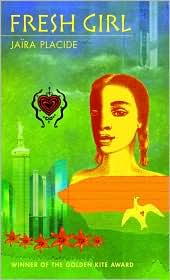
author: Jaïra Placide
publisher: Wally Lamb Books, 2002
main character: Mardi Desravines
While reading Fresh Girl, I couldn’t help but remember Uma Krishnaswami’s musings on trends in YA books set in countries other than the US, although this book is set in the US. Placide was actually born and raised in the US but was so affected by events in Haiti during its coup d’etat that she wrote Fresh Girl.
Mardi is a young teen who spent much of her childhood in Haiti in her grandmother’s home. Her favorite uncle is politically active and as the political condition deteriorates, her family decides to buy first class tickets to return to the US. But something happens while the family is in transition, something that causes Mardi to no longer trust her favorite Uncle. Desravines builds our suspicion as she drops crumbs about Mardi’s past. I don’t want to remember too much, but these things are like sleeping hiccups in my head. We see the goodness in Uncle Perrin and wonder what he could have done for Mardi to despise him so much.
Mardi is also crushin’ on Santos. Haven’t we all had that love we gush on from afar? That dreamboat who, should he ever dare speak to us would leave us so tongue tied that we could do nothing but make a fool of ourselves? We see only his perfection and could easily look foolish because of him. Today I think my heart will stop. Santos blew me a kiss. That’s not what I prayed for in church but it’s just as good. Through Mardi’s eyes, we see how good and wonderful Santos is, although those around her warn her about this boy.
Mardi’s story is rich with well developed characters who depict bits of Haitian culture. Some speak only patois. Many have been in the US for quite some time, but are considered to be ‘boat people’. Families try to protect their young girls from any sexual knowledge or experience, yet the children are as inquisitive as most growing teens.
When Mardi is finally able to reveal secrets she’s buried deep within, she’s able to firmly, comfortably and bravely by herself. She can finally see things as they really are and she’s able to say what she means and mean what she says. She’s given up her childhood.
I think Placide wrote this story so that young adult readers would know that while Haitian Americans don’t all have one story, they do have a common history and heritage. I look around the kitchen. In the dark my eyes can still recognize the big cooking spoons, the I LOVE HAITI wooden machete souvenir, the local bodega calendar of a topless woman, the three pictures of fruits, the floral plastic tablecloth, toaster, blender, Brillo, Palmolive, and the patchwork quilt rag that hangs on the refrigerator door. I have good eyes. I can even see the fading crack on the wall in the shape of Hispaniola.
What I think?
I think I will be all right.
Because I am good.
Still.
 Cotton Quilts Edi
Wow, this books sounds fantastic. I will look for it. Thanks, Edi!
LikeLike
I remember hearing about this book when it came out, and somehow I neglected to read it–thanks for bringing it to our attention, Edi!
LikeLike